The Ecommerce Packaging Checklist: Every Supply You Need to Ship Orders
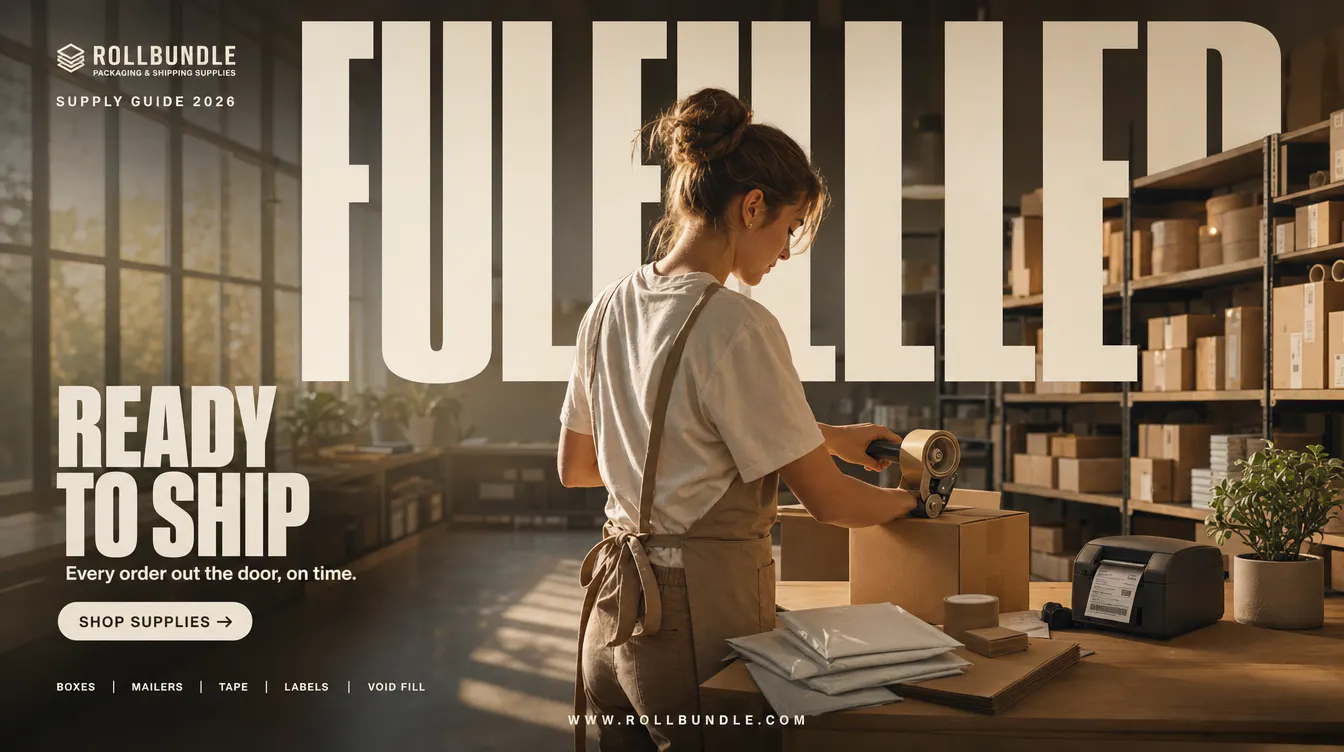
The hidden cost of figuring out supplies as you go
Most online stores don't decide on a packaging system. They accumulate one.
A run to the office-supply store for a box of mailers. A roll of tape grabbed off a hardware-store shelf at retail price. A bag of packing peanuts that doesn't quite fit the boxes you already have. It works — until the day you ship 40 orders instead of four, run out of the one box size that fits your best-seller, and realize you've been paying twice the going rate for everything.
Packaging is the most overlooked line item in ecommerce. It rarely shows up in a pitch deck, but it touches margin, delivery speed, damage rates, return costs, and the first physical impression a customer has of your brand. Getting it right isn't about buying more — it's about stocking the right supplies in the right quantities, at a price that doesn't erode with every reorder.
This is the checklist we'd hand a store that's outgrown the kitchen-table phase but isn't ready for a third-party warehouse. Work through it layer by layer.
Start with the outer layer: boxes vs. poly vs. padded mailers
Your outer packaging is the single biggest driver of both shipping cost and damage rate, so start here.
- Corrugated boxes are for anything rigid, fragile, or heavier than a couple of pounds. Stock two or three sizes that match your actual products, not a one-size-fits-all box you cram everything into. A box that's too big costs more to ship (carriers bill on dimensional weight, not just actual weight) and needs more void fill to keep contents from rattling.
- Poly mailers are for soft, non-fragile goods — apparel, textiles, anything that bends. They're lighter and cheaper than boxes and take up almost no storage space flat.
- Padded / bubble mailers sit in between: light protection for small items like accessories, books, or electronics that don't justify a full box.
The most common and most expensive mistake is right-sizing failure — shipping a small product in a large box. Measure your top five SKUs, match box and mailer sizes to them, and you'll cut dimensional-weight surcharges immediately.
## Protect what's inside: void fill and cushioning
Once the outer layer fits, fill the gaps. Empty space lets products shift and break in transit, and damage is far more expensive than the cushioning that prevents it — you eat the product cost, the return shipping, and the replacement.
Match the cushioning to the product:
- Kraft paper / void fill paper — fast, recyclable, ideal for filling gaps around boxed goods.
- Bubble cushioning — wrap-around protection for fragile or breakable items.
- Air pillows — cheap, light gap-fill for non-fragile products; great storage-to-volume ratio since you inflate on demand.
- Foam or corner protectors — for sharp edges, glass, framed goods, or electronics.
You don't need all four. Pick the one or two that fit what you actually ship, and keep them within arm's reach of your packing station.
Seal it properly: tape and dispensers
Cheap tape is a false economy. Tape that won't stick in the cold, splits down the middle, or needs three passes to hold a seam costs you in failed seals, in-transit openings, and packing-station time.
- Use proper carton sealing tape (2"–3" wide) — not the small stationery tape from a desk drawer.
- Get a tape dispenser / gun. It roughly doubles packing speed and gives a cleaner, more reliable seal than tearing strips by hand.
- For higher-value or regulated shipments, water-activated (gummed) tape bonds to the box fibers and visibly shows tampering.
This is the cheapest upgrade on the whole list with the biggest payoff in throughput.
## Label it: shipping labels, packing slips, and branded labels
Labels are where packing-station friction quietly piles up.
- Thermal shipping labels (4"×6") printed on a thermal printer are the standard once you're past a handful of orders a day — no ink, no taping a sheet of paper to the box, and they don't smudge.
- Packing slips confirm contents and double as a returns reference. Stock plain slips or printer-friendly sheets.
- Branded or custom labels — a logo sticker that seals the mailer or tops the tissue — turn a plain parcel into a brand touchpoint for very little money.
If you're still printing on standard paper and taping it on, a thermal label printer plus a stack of labels is the upgrade that pays for itself fastest.
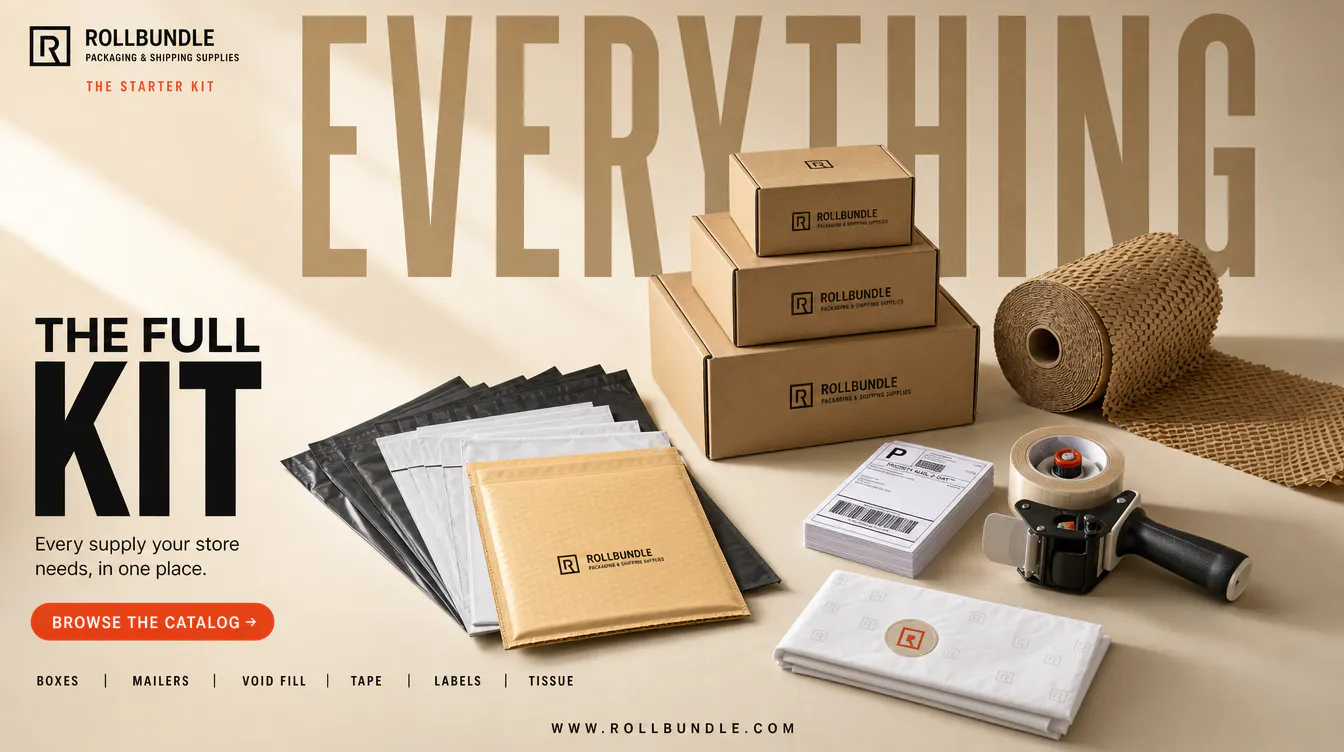
The unboxing layer: turn packaging into marketing
This layer is optional — but it's the cheapest marketing you'll ever buy.
The box arriving is the one guaranteed moment a customer engages with your physical brand. A sheet of tissue paper, a branded sticker, a small thank-you card or insert with a discount code costs cents per order and drives repeat purchases, referrals, and the kind of unboxing photos that become free social proof.
Start minimal: tissue plus a sticker. Add inserts once you've proven the basics ship reliably.
How much to stock: simple reorder math
Running out of your one critical box size stops shipping entirely. Overstocking ties up cash and floor space. The fix is a basic par-level system — no software required:
1. Daily usage — how many of each item do you go through on an average day?
2. Lead time — how many days from placing a reorder to it arriving?
3. Safety stock — a buffer for demand spikes (a sale, a holiday, a viral moment).
Reorder point = (daily usage × lead time) + safety stock.
Example: you use ~50 medium boxes a day, reorders take 3 days to arrive, and you want a 2-day buffer. Reorder when you hit `(50 × 3) + (50 × 2) = 250` boxes left. Set that number for every core supply and you'll never panic-buy at retail prices again.
The shorter and more reliable your supplier's delivery, the less safety stock you need to carry — which is exactly why fulfillment speed matters as much as unit price.
## When wholesale beats retail
Buying supplies one retail pack at a time feels harmless because each purchase is small. Across a year of shipping, it's one of the largest controllable costs in the business.
Wholesale wins on three fronts:
- Unit price — per-item cost drops sharply at case and pallet quantities. On a high-volume SKU like tape or your most-used box, the savings compound on every single order.
- Consistency — same box, same mailer, same dimensions every time, so your packing process and dimensional-weight math stay predictable.
- Stockout protection — a supplier with deep inventory and same-day fulfillment means a reorder lands before you run dry, letting you carry less safety stock and free up cash.
The break-even is simple: if you ship consistently, the per-order savings on wholesale supplies almost always clear the cost of buying in larger quantities — and you stop paying the retail "convenience" markup on every roll and box.
Your starter supply checklist
Copy this, fill in the sizes that match your products, and you've got a complete packing station:
- [ ] Boxes — 2–3 corrugated sizes matched to your top SKUs
- [ ] Poly mailers — for soft, non-fragile goods
- [ ] Padded mailers — for small items
- [ ] Void fill — paper, air pillows, or bubble (pick what fits your products)
- [ ] Carton sealing tape + a tape gun
- [ ] Thermal shipping labels (4"×6") + printer
- [ ] Packing slips
- [ ] Branded touch — tissue, stickers, or inserts (optional)
- [ ] Reorder points set for every core supply
Get these nine things right and packaging stops being a weekly fire drill — it becomes a quiet, predictable system that protects your margin and your products.
Stocking up? Rollbundle carries 20,000+ packaging and shipping supplies at wholesale pricing, with same-day fulfillment from six US warehouses — so your reorders arrive before you run out. [Browse the catalog →](/categories)